
Category Archives: Extensions and reflections

Epistemic fluency perspectives in teaching and learning practice

How can epistemic fluency perspectives be enacted in daily learning and teaching work? This presentation overviews the design of a blended course Systems, Change and Learning that fundamentally builds on the ideas of epistemic fluency. The course draws together three modes of human inquiry: systems thinking, design practice and responsive action. Through reflective engagement with ideas from different disciplinary domains and teamwork on practical innovation challenges, students begin to appreciate the need to accommodate diverse perspectives and learn to combine diverse ways of knowing. This is not a “flagship” course – it never received any extra funding or other “external” support – but a course that emerged gradually through our daily work with students. By being “usual” and simultaneously “different” this course has celebrated students’ deep  engagement, collaboration and positive feedback. A brief description of our approach is in the presentation and this document. Below is a short summary.
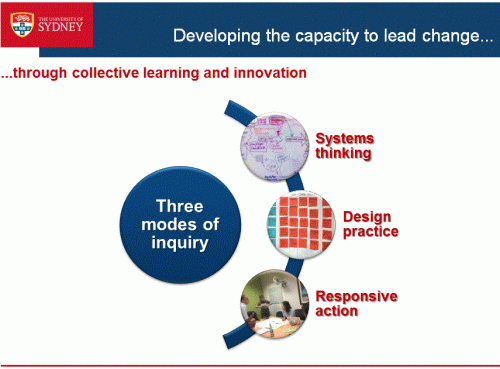
three modes of inquiry

Summary: Learning to lead innovation and change

Capacities to drive collective learning,  jointly address complex practical challenges and create innovative solutions are seen as essential for future graduates. How can we prepare students to lead complex collaborative learning, change and innovation projects? How can we help them to develop the knowledge and skills needed for resourceful teamwork with other people who have different areas of expertise, experiences, and interests? Continue reading

Understanding the learning brain in the world

How does the brain learn? Some answers to this question are briefly summarised in this presentation – which was made in the symposium “The Mind and the Machine: Brain, mind and digital learning environments” at ascilite 2015. (These ideas are elaborated in our Epistemic fluency book.)

Many of our insights draw on what we call the “slow” or “long” neurosciences – which study cultural and social evolution of the human brain and mind (evolutionary neuroscience, neuroanthropology, neuroarchaeology, neurolinguistics, etc.) – rather than just the traditional “fast” cognitive neuroscience that look primarily at microprocesses in the human brain. Overall, it is not hard to see that neurosciences, broadly taken, now offer a lot of useful insights for teaching, learning and educational design. The emerging field of (“fast”) educational neuroscience has the potential to solve some big educational issues, but the contributions of the “slow” neurosciences are likely to be even more profound and radical.

slow neurosciences Continue reading

Why more scientists are needed in the public square

This weekend, The Conversation published quite interesting article entitled: “Why more scientists are needed in the public square”. It is written by the University of California’s President Janet Napolitano as a call for “all scientists” to step out from their labs into public arena and convey, in a jargon free language, social importance of their work. The article is squarely located in the US presidential election season, but there are a number of thought-provoking ideas from the epistemic fluency perspective (a brief comment that we posted in the morning is copied below). Overall, this article clearly shows that challenges related to the (lack of) epistemic fluency are both deep and widespread across science, society and politics. Continue reading

Epistemic fluency, interdisciplinarity and expertise

When our students and colleagues hear the term “epistemic fluency” for the first time they usually ask us two common questions: “Is it about interdisciplinarity?”; “Is it about expertise?” Perhaps the most straightforward answer is: “Yes” and “Yes”. Epistemic fluency is about interdisciplinarity and about expertise. To put it short – epistemic fluency is a capacity that underpins interdisciplinary expertise. However, this answer warrants some explanation of what we mean by “interdisciplinarity” and what we mean by “expertise”.
Continue reading

A 21st-century higher education: training for jobs of the future

Today’s Conversation published quite interesting article about higher education and skills for 21st-century jobs: A 21st-century higher education: training for jobs of the future, by Belinda Probert and Shirley Alexander

We posted our comment on it. Here is a copy of it

Thank you for this interesting article. I completely agree that the “challenges for tertiary education are significant” in this area, and particularly that “universities will need to give teaching and curriculum design a greater priority.” One of additional key challenges is that current pedagogies for “21st century jobs” often draw on a very limited understanding about knowledge, skills and other capabilities needed for innovation and flexible, skilful, future-oriented knowledge work. Teaching to innovate should be informed by much deeper understanding of how people learn to innovate.
Continue reading