Indexing Gratitude

I want to put on record my thanks to colleague and lead author Lina Markauskaite for her determination and skill in producing an exemplary index for the Epistemic Fluency book. A heroic undertaking, now completed. There may still be a few little odds and ends to sort out before the manuscript finally goes to print, but the index was the last big task.

Index snippet

Bridging professional learning, doing and innovation through making epistemic artefacts

We added to our slideware our presentation “Bridging professional learning, doing and innovation through making epistemic artefacts”, presented last week at the Practice-Based Education Summit “Bridging Practice Spaces” at Charles Sturt University. This presentation draws on the ideas from Chapter 8: Objects, things and artefacts in professional learning and doing of the book “Epistemic Fluency and Professional Learning“. It discusses how students’ work on making various artefacts for their assessments in courses that prepare them for professional practice bridges knowledge learnt in university setting with knowledge work in workplaces.

The gist of our argument can be summarised as follows:

  1. Professional expertise is inseparable from capacities to (co-)construct epistemic environments that enhance knowledgeable actions.
  2. Such expertise is grounded in embodied, situated professional knowledge work.
  3. Much of this work is done by (co-)creating epistemic artefacts that embody actionable knowledge.
  4. Productive epistemic artefacts connect the object (‘why’ of work) and the thing (‘what’ of work) through action (‘know how’) and ways of thinking that underpin situated professional innovation (ie. epistemic fluency)

In learning, much of the value of the epistemic artefacts comes from their dual and deeply entangled nature: they are simultaneously objective and grounded in situated experiences (aka. subjective). They embody actionable knowledge, and the activity through which they are constructed embodies knowledgeable action. They are reflective and projective.
Learning through making artefacts line

Continue reading

Epistemic fluency perspectives in teaching and learning practice

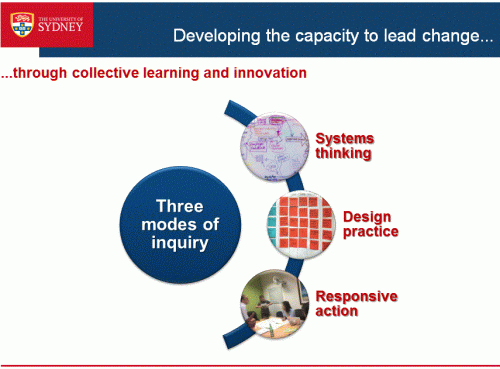
How can epistemic fluency perspectives be enacted in daily learning and teaching work? This presentation overviews the design of a blended course Systems, Change and Learning that fundamentally builds on the ideas of epistemic fluency. The course draws together three modes of human inquiry: systems thinking, design practice and responsive action. Through reflective engagement with ideas from different disciplinary domains and teamwork on practical innovation challenges, students begin to appreciate the need to accommodate diverse perspectives and learn to combine diverse ways of knowing. This is not a “flagship” course – it never received any extra funding or other “external” support – but a course that emerged gradually through our daily work with students. By being “usual” and simultaneously “different” this course has celebrated students’ deep  engagement, collaboration and positive feedback. A brief description of our approach is in the presentation and this document. Below is a short summary.

three modes of inquiry

Summary: Learning to lead innovation and change

Capacities to drive collective learning,  jointly address complex practical challenges and create innovative solutions are seen as essential for future graduates. How can we prepare students to lead complex collaborative learning, change and innovation projects? How can we help them to develop the knowledge and skills needed for resourceful teamwork with other people who have different areas of expertise, experiences, and interests? Continue reading

Teaching and learning to think and work across disciplinary and professional boundaries

Last month we co-organised a symposium on interdisciplinary teaching and learning at The Sciences and Technologies of Learning Research Fest. As some colleagues were asking for access to our slides, we have uploaded them into our “slideware”. There are two presentations:

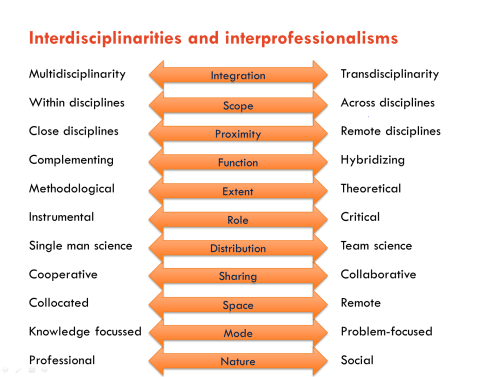
The first presentation “Teaching people to think and work across disciplinary and professional boundaries” comes from the symposium session (Symposium abstract is below). In our presentation, we provided an overview of the “zoo” of different definitions, taxonomies and classifications of interdisciplinarity and inter-professionalism. Most of these ideas are based on chapters in the Oxford Handbook of Interdisciplinarity. We also introduced some current discussions about the “shapes” of interdisciplinary expertise. Brief explorations of these ideas could be found in the linked pages about T-shaped and E-shaped people.

taxonomies of interdisciplinarity

The second presentation “Learning to work across boundaries – opportunities for research and innovation” was a summary (by Lina) of the symposium – as part of the Research Fest’s closing plenary discussion. It briefly outlines our view of: i) what interdisciplinary skillfulness looks like, and ii) what kinds of educational research could help us to improve interdisciplinary teaching and learning.

interdisciplinarity skilfulness

Continue reading

Understanding the learning brain in the world

How does the brain learn? Some answers to this question are briefly summarised in this presentation – which was made in the symposium “The Mind and the Machine: Brain, mind and digital learning environments” at ascilite 2015. (These ideas are elaborated in our Epistemic fluency book.)

Many of our insights draw on what we call the “slow” or “long” neurosciences – which study cultural and social evolution of the human brain and mind (evolutionary neuroscience, neuroanthropology, neuroarchaeology, neurolinguistics, etc.) – rather than just the traditional “fast” cognitive neuroscience that look primarily at microprocesses in the human brain. Overall, it is not hard to see that neurosciences, broadly taken, now offer a lot of useful insights for teaching, learning and educational design. The emerging field of (“fast”) educational neuroscience has the potential to solve some big educational issues, but the contributions of the “slow” neurosciences are likely to be even more profound and radical.

slow neurosciences Continue reading