Yearly Archives: 2015

Teaching and learning to think and work across disciplinary and professional boundaries

Last month we co-organised a symposium on interdisciplinary teaching and learning at The Sciences and Technologies of Learning Research Fest. As some colleagues were asking for access to our slides, we have uploaded them into our “slideware”. There are two presentations:

The first presentation “Teaching people to think and work across disciplinary and professional boundaries” comes from the symposium session (Symposium abstract is below). In our presentation, we provided an overview of the “zoo” of different definitions, taxonomies and classifications of interdisciplinarity and inter-professionalism. Most of these ideas are based on chapters in the Oxford Handbook of Interdisciplinarity. We also introduced some current discussions about the “shapes” of interdisciplinary expertise. Brief explorations of these ideas could be found in the linked pages about T-shaped and E-shaped people.
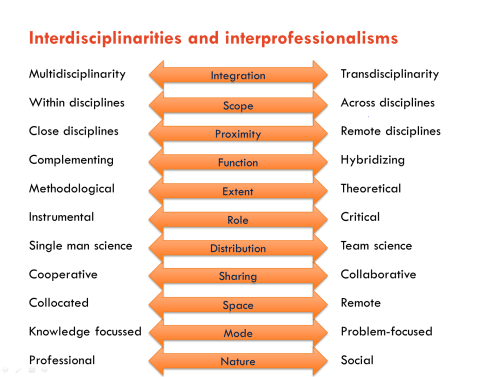
taxonomies of interdisciplinarity

The second presentation “Learning to work across boundaries – opportunities for research and innovation” was a summary (by Lina) of the symposium – as part of the Research Fest’s closing plenary discussion. It briefly outlines our view of: i) what interdisciplinary skillfulness looks like, and ii) what kinds of educational research could help us to improve interdisciplinary teaching and learning.

interdisciplinarity skilfulness

Continue reading

Understanding the learning brain in the world

How does the brain learn? Some answers to this question are briefly summarised in this presentation – which was made in the symposium “The Mind and the Machine: Brain, mind and digital learning environments” at ascilite 2015. (These ideas are elaborated in our Epistemic fluency book.)

Many of our insights draw on what we call the “slow” or “long” neurosciences – which study cultural and social evolution of the human brain and mind (evolutionary neuroscience, neuroanthropology, neuroarchaeology, neurolinguistics, etc.) – rather than just the traditional “fast” cognitive neuroscience that look primarily at microprocesses in the human brain. Overall, it is not hard to see that neurosciences, broadly taken, now offer a lot of useful insights for teaching, learning and educational design. The emerging field of (“fast”) educational neuroscience has the potential to solve some big educational issues, but the contributions of the “slow” neurosciences are likely to be even more profound and radical.

slow neurosciences Continue reading

Epistemic fluency: Chapter abstracts and keywords

We added a document with chapter abstracts and keywords on Epistemic fluency and professional education book page [PDF]. Perhaps this is the easiest way to find out what this book is about. Below are 100 most frequent words in this book.eFluency 100

Why more scientists are needed in the public square

This weekend, The Conversation published quite interesting article entitled: “Why more scientists are needed in the public square”. It is written by the University of California’s President Janet Napolitano as a call for “all scientists” to step out from their labs into public arena and convey, in a jargon free language, social importance of their work. The article is squarely located in the US presidential election season, but there are a number of thought-provoking ideas from the epistemic fluency perspective (a brief comment that we posted in the morning is copied below). Overall, this article clearly shows that challenges related to the (lack of) epistemic fluency are both deep and widespread across science, society and politics. Continue reading

Epistemic fluency, interdisciplinarity and expertise

When our students and colleagues hear the term “epistemic fluency” for the first time they usually ask us two common questions: “Is it about interdisciplinarity?”; “Is it about expertise?” Perhaps the most straightforward answer is: “Yes” and “Yes”. Epistemic fluency is about interdisciplinarity and about expertise. To put it short – epistemic fluency is a capacity that underpins interdisciplinary expertise. However, this answer warrants some explanation of what we mean by “interdisciplinarity” and what we mean by “expertise”.
Continue reading