
We will be presenting our paper that discusses various designs of tasks for assessing “workplace readiness” on the 27th of June, at the HERDSA 2017 Conference. If you will be attending the conference and interested, check the program and come to the session. The abstract is below. We will post our slides and link to the full paper after the conference.
Preparing students for the workplace through designing productive assessment tasks: An actionable knowledge perspective
Lina Markauskaite and Peter Goodyear
Abstract
Preparing students for the workplace and assessing their readiness are often major challenges for university teachers. What kinds of concrete tasks help students develop professional capacities needed for situated knowledgeable action in a broad range of possible future workplace settings?
Our research examined assessment tasks that university teachers set for students in courses that were preparing them for work placements in five professions: nursing, pharmacy, teaching, social work, and school counselling. We combined ‘actionable knowledge’ and ‘objectual practice’ perspectives and investigated what students were asked to do, what they were expected to learn and how. Specifically, we analysed the nature of the objects that teachers selected for assessment tasks and the nature of the concrete artefacts that students were asked to produce.
Our results show some fundamental differences in teachers’ choices of objects. They ranged from basic and very specific aspects of professional work to some of the hardest and most broad-ranging challenges in the profession. The tasks also required students to engage in the production of a wide range of artefacts. We classified these as ‘cultural artefacts’, ‘conceptual artefacts’ and ‘epistemic artefacts’.
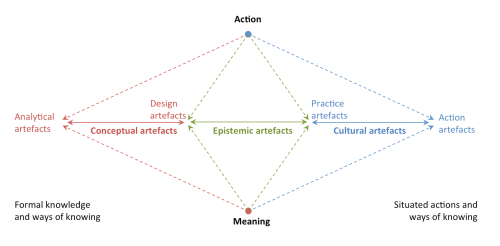
Our discussion draws parallels between these three kinds of artefacts and the notions of ‘work ready’, ‘work knowledgeable’ and ‘work-capable’ graduates, respectively. We argue that teachers, through task designs, shape ways in which students learn to link action (skill) with meaning (knowledge). Our findings raise some important questions about the kinds of authentic tasks that help prepare work-capable graduates for future learning.
 Educational research is, of course, one of the most epistemically diverse and challenging research fields. Actionable knowledge and epistemic fluency are big themes in it. Some people have been asking us if we wrote anything about this. Not recently, but below there are summaries and links to some our earlier papers that should give an insight into our ways of thinking about epistemological landscape of educational research. They are written during 2010–2011, but the main messages are still very relevant. The first paper discusses connections between epistemic fluency, educational research methods and educational design (or educational research as design). The next two papers talk about emerging technology-mediated research methods and implications for educational research. (NB: these two papers have been written in the era when “learning analytics” yet to be invented, but fundamental epistemological questions about big data vs. rich data, digital materiality, digital knowledge, educational research infrastructures, etc. are still pretty “hot”). Of course, others have been writing about these topics too, e.g. see Deb Hayes and Catherine Doherty’s
  Recently we have been writing some papers on various aspects of the epistemic fluency as well as preparing for several conferences. The following two papers will be presented at
  epistemic fluency